Mainline Protestant (PCUSA / ELCA / UMC)
- 6Axes
- 4Poles named
- 17Others
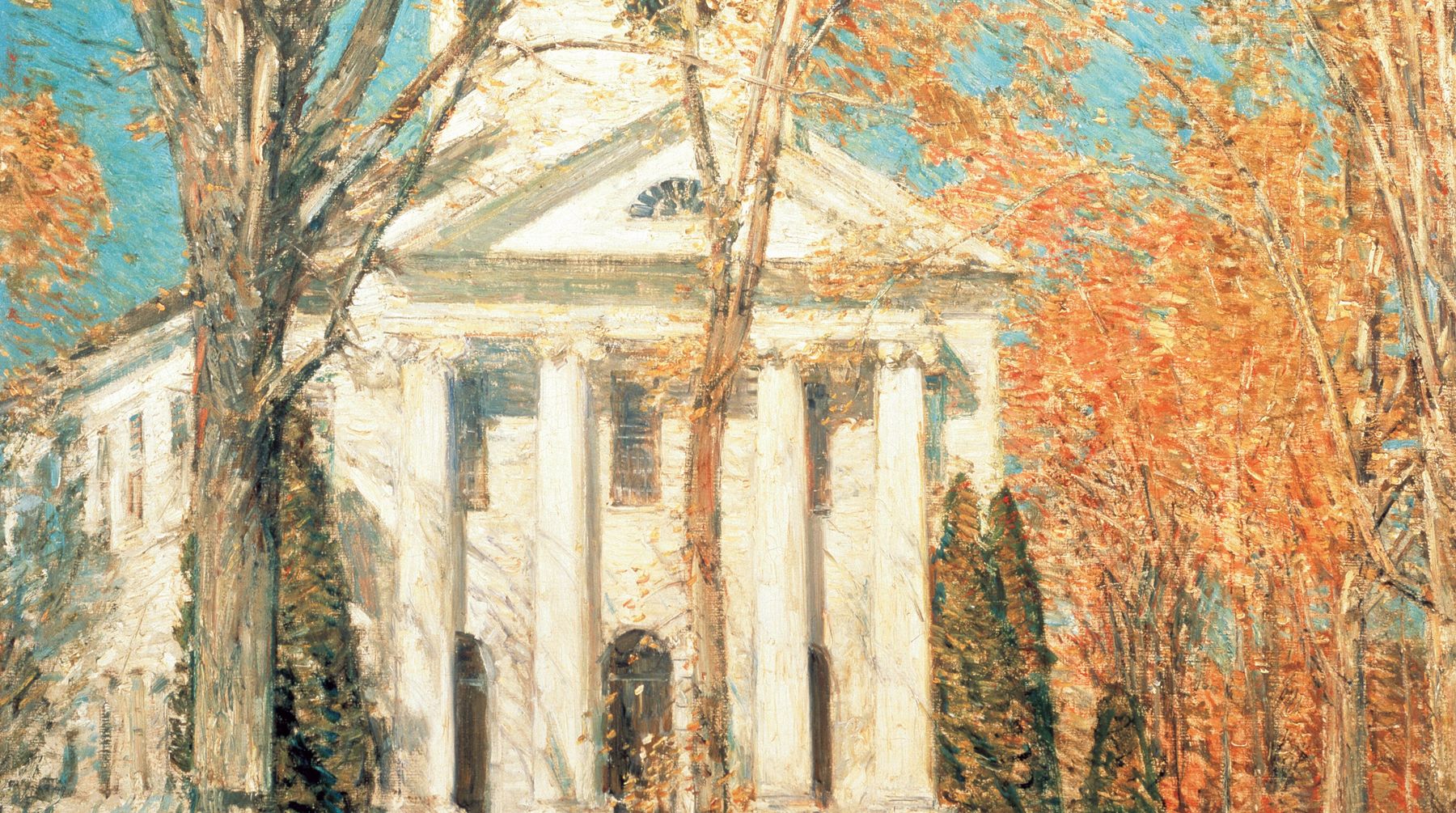
Picture: Church at Old Lyme, Childe Hassam, 1905. Buffalo AKG Art Museum, Buffalo.
Mainline Protestant in a sentence
Three of the largest American denominations, Presbyterian, Lutheran and Methodist, sharing printed liturgies, infant baptism and ordained women. All three read Scripture alongside the creeds, scholarship and the church’s long experience.
Sacramental, one-people-of-God, liturgy-leaning
What marks it out
The Table is the clearest mark. All three teach that God actually gives something in the sacraments rather than merely reminding you of something, and all three baptize infants, which is why this sketch sits so far towards the sacramental end.
On grace the map names nothing, and that is honest rather than evasive. Three inheritances share one band: Lutherans who say conversion is God’s work alone, Presbyterians who confess election, Methodists who say grace reaches everyone and can be refused. Nobody here is made to choose.
Authority picks no side either. Scripture comes first in all three governing books, but so does reading it with the creeds, with scholarship and with the church’s experience, which Methodists shorten to Scripture, tradition, reason and experience. Neither “the Bible alone” nor “the Bible plus a teaching office” fits.
Worship leans liturgical without being fixed: service books and a church year, followed closely in one congregation and lightly in the next. None of the three has ever taught that the gifts of the Spirit ceased, though tongues are not expected either, so that reading sits open.
One more thing ties the three together on a Sunday morning. All three commend the Revised Common Lectionary, the three-year cycle of set readings published in 1992 and built on the Roman Catholic lectionary of 1969, so a Presbyterian, a Lutheran, a Methodist and a Catholic can hear much the same Scripture on the same day. All three ordain women, which is one of the plainest lines between this family and the conservative evangelical bodies.
Did you know?
-
The PCUSA does not have a confession; it has twelve, bound into a Book of Confessions running from the Nicene Creed to the Confession of Belhar, the short statement written in South Africa against apartheid and added in 2016.
PC(USA) 222nd General Assembly, 2016, adopting Belhar as the twelfth confession; PC(USA) Book of Confessions.
-
Between 2019 and the end of 2023 more than 7,600 congregations, about a quarter of the total, left the United Methodist Church under a temporary exit rule that expired on 31 December 2023.
UMC Book of Discipline ¶2553, expired 31 December 2023; Christianity Today, December 2023.
Where it came from
Each came out of the Reformation by a different door: the ELCA from Luther, the PCUSA from Calvin by way of Scotland, the UMC from Wesley and the Church of England. They are near relatives by agreement as well as descent: the ELCA has been in full communion with the PCUSA since 1997, the Episcopal Church since 2001 and the UMC since 2009, so their ministers can serve in each other’s churches.
Where it sits on all six questions
Your answers are marked. From your result on . See your result
In the hatched middle the quiz names neither pole.
Which traditions are closest?
Nearness is not agreement: two families can land in the same band for different reasons.
- Anglican (broad) Closest 87%match
- Wesleyan / Methodist 79%match
- Catholic (Roman and Eastern) 69%match
- Lutheran (confessional) 69%match
- Eastern Orthodox 65%match
- Presbyterian / Reformed (confessional) 55%match
What we read
Read to place this tradition
PCUSA Book of Confessions and Book of Order W-3; ELCA "The Use of the Means of Grace" (1997); UMC Book of Discipline.
-
The Use of the Means of Grace (ELCA, 1997)
Short and practical: the plainest account of why these churches sit where they do on baptism and communion.
-
The Confession of Belhar (1986)
Two pages written against apartheid, now one of the twelve confessions a PCUSA minister promises to be guided by.