
Mary of Bethany
Martha's sister, whom Jesus defended when Martha wanted her to stop listening to Him and help with the meal, and again when Judas complained that the perfume she poured on His feet should have been sold for the poor.
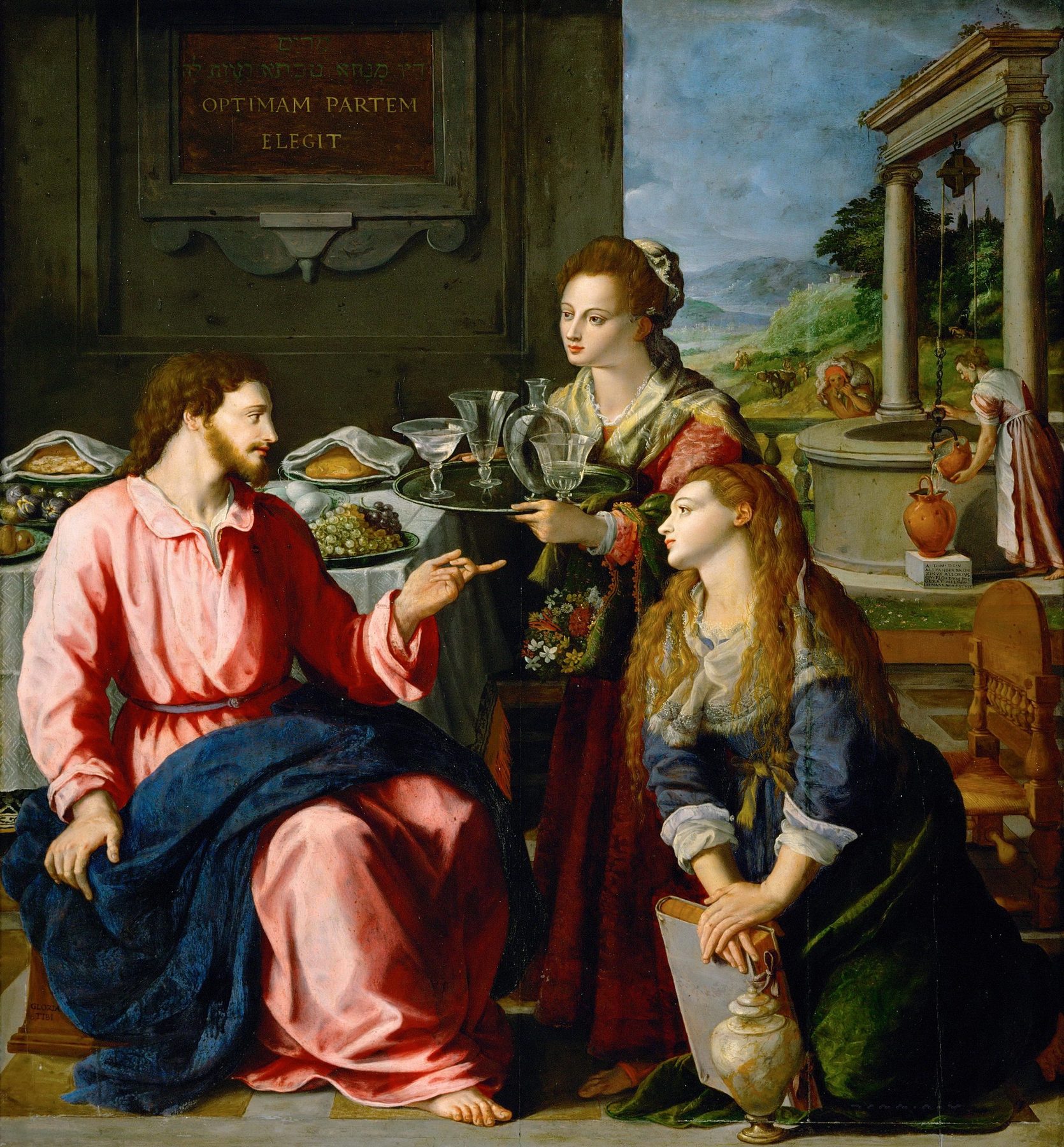
Picture: Christ in the House of Martha and Mary, by Alessandro Allori, 1605. Kunsthistorisches Museum, Vienna.
Who was Mary?
Mary of Bethany lived in a village near Jerusalem in the first century with her sister Martha and her brother Lazarus, whom Jesus raised from the dead. For centuries the West took her to be both Mary Magdalene and the sinful woman who wet Jesus' feet with her tears, until 1969, when Rome stopped honouring them as one woman.
at a glance
in numbers
- times she is found at Jesus' feet3
- Listening while Martha served
- Grieving after Lazarus died
- Pouring perfume on His feet
- denarii, the price Judas put on her perfume300
- Nearly a year's wages, poured out at one dinner
- days Lazarus lay in the tomb4
- Before Jesus came and called him out
- The Orthodox call him Lazarus of the Four Days
did you know?
-
Mary speaks only once in the Bible apart from the message she and Martha sent Jesus, and she repeats word for word what Martha had told Him a little earlier: “Lord, if You had been here, my brother would not have died.”
John 11:21 and 11:32 -
“Jesus wept,” the shortest verse in most English Bibles, comes moments after He saw Mary weeping.
John 11:33-35 -
Sulpicius Severus praised an empress for being like both sisters at once. At her husband's palace she hung on every word of the bishop Martin of Tours and cooked his meal and served it herself, so that she “both served like Martha and listened like Mary.”
Sulpicius Severus, Dialogues, book 2, chapters 6 and 7
- When
- The first century, in the years of Jesus' ministry
- Home
- The village of Bethany on the Mount of Olives, a little less than two miles from Jerusalem
- Family
- Her sister Martha and her brother Lazarus, whom Jesus raised from the dead
- Her perfume
- Pure nard, which the Roman writer Pliny the Elder ranked first among the perfumes of Rome
- Often confused with
- Mary Magdalene and the sinful woman of Luke 7, long counted as one woman with her in the West
- Early shrine
- A church on the road into Bethany, where she met Jesus after Lazarus died. The pilgrim Egeria saw Jerusalem's Christians stop to pray there in the early AD 380s.
- Bethany today
- El-Azariye, a name that comes from Lazarus
- In the Bible
- Luke 10:38-42, John 11:1-45 and John 12:1-8. Matthew 26:6-13 and Mark 14:3-9 describe the anointing at Bethany without naming her.
- Honoured by
- The Orthodox, Catholic, Anglican and Lutheran churches
- In art
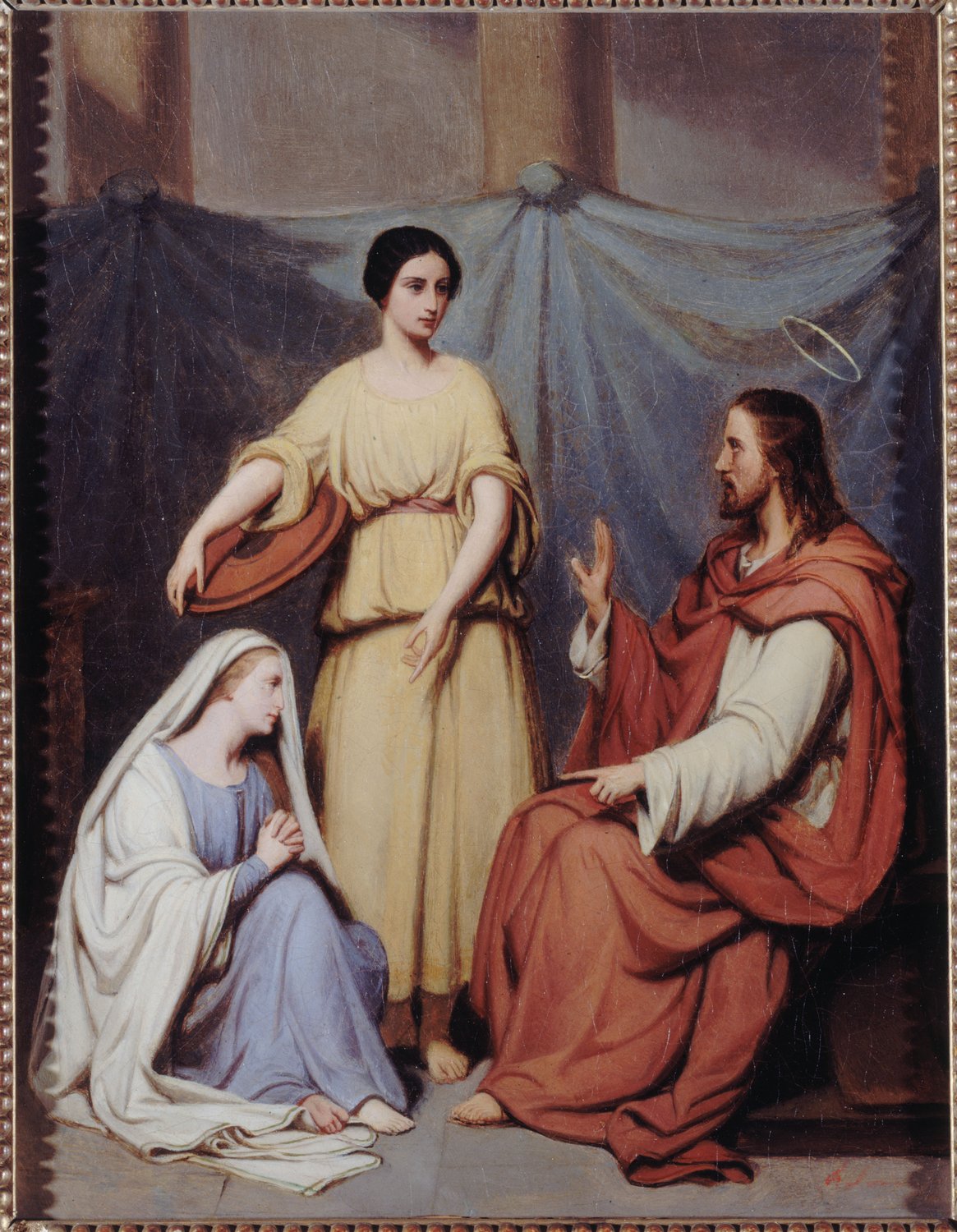
- Most often shown at Jesus' feet while Martha serves, as in paintings by Vermeer, Allori and Henry Scheffer
 The Oak
Her personality type
Sure of herself, and at her best when life is quiet.
In Pope Gregory the Great's terms
- Confident
- Tranquil mind
Our reading, from the Christian Personality Test. Mary is the quieter sister and never defends herself in the Bible. Jesus answered for her when Martha complained of serving alone and when Judas said the perfume should have been sold. After Lazarus died, Martha went out to meet Jesus, while Mary stayed sitting in the house. Her sister is the Lookout, the Oak's opposite.
See The Oakfeast days
East and West
West
- Jul29
Catholic memorial of Saints Martha, Mary and Lazarus since 2021, also kept by the Church of England, the Episcopal Church and Lutherans.
East
- Jun4
Orthodox feast of the righteous Martha and Mary, sisters of Lazarus. Churches on the old calendar keep it 13 days later, on 17 June.
Two Sundays after Easter the Orthodox honour the women who brought spices to Jesus' tomb, and they count the two sisters among them. They also keep the raising of Lazarus on Lazarus Saturday, the day before Palm Sunday.
The Catholic feast on 29 July began with the Franciscans in 1262 as Martha's day, a week after the feast of Mary Magdalene, who was then honoured in the West as Martha's sister.
what others said of her
Wherever the gospel is preached in all the world, what she has done will also be told in memory of her.
Martha was intent, how she might feed the Lord; Mary intent how she might be fed by the Lord.
So Mary refreshed Him with precious ointment, as He had refreshed her with His exalted teaching.
I have longed to sit at the feet of the Lord with Mary, to take in the words of His mouth … I am compelled to serve with Martha in external affairs
her life in five moments
Martha's home
On Jesus' journey to JerusalemAt His feet while Martha served
Jesus was travelling toward Jerusalem with His disciples when Martha welcomed Him into her home. Her sister Mary sat at His feet and listened to His teaching, while Martha was busy with all the preparations for the meal.
Martha went to Jesus and said, “Lord, do You not care that my sister has left me to serve alone? Tell her to help me!” Jesus answered, “Martha, Martha, you are worried and upset about many things. But only one thing is necessary. Mary has chosen the good portion, and it will not be taken away from her.”
Luke 9:51; 10:38-42Across the Jordan
Winter, after the Feast of Dedication (Hanukkah)“Lord, the one You love is sick”
Not long before His crucifixion, a crowd in Jerusalem tried to stone Jesus for saying that He and the Father are one, and He went away across the Jordan. Lazarus fell sick at Bethany while He was there. Mary and Martha sent Him word, “Lord, the one You love is sick,” and Jesus answered that the sickness would not end in death but was “for the glory of God.”
Jesus loved Martha, Mary and Lazarus. When He heard that Lazarus was sick, He stayed where He was two more days, and then He told His disciples, “Lazarus is dead, and for your sake I am glad I was not there, so that you may believe. But let us go to him.”
John 10:22-40; 11:1-16Bethany
Four days after the burialAt His feet in her grief
Many people had come out from Jerusalem to comfort Martha and Mary after their brother Lazarus died. When Martha heard that Jesus was coming, she went out to meet Him, but Mary stayed at home. Martha came back and called her sister aside to tell her, “The Teacher is here and is asking for you.”
Mary got up at once and went to Him, with the mourners following because they thought she was going to the tomb to weep. She fell at His feet and said, “Lord, if You had been here, my brother would not have died.” When Jesus saw her and the mourners weeping, He was troubled, and He wept.
John 11:18-35Lazarus's tomb
The day Jesus arrived“Lazarus, come out!”
Jesus asked Mary and the mourners with her where they had laid Lazarus. “Come and see, Lord,” they answered, and He went with them to the tomb, a cave closed with a stone. He told them to take the stone away, but Martha warned that after four days the body would smell. Jesus answered that if she believed, she would see the glory of God.
Once the stone was moved, Jesus prayed and called out, “Lazarus, come out!” The dead man came out, still bound in strips of linen. Many of the mourners who had come to comfort Mary believed in Jesus, but others told the Pharisees. The chief priests and Pharisees called a council, afraid that everyone would come to believe in Him. From that day they plotted to kill Him (John 11:47-53).
John 11:34-53Bethany
Six days before the PassoverA pint of pure nard
Jesus came to Bethany again six days before the Passover, and a dinner was given for Him there. Martha served, while Lazarus sat at the table with Him. Mary took about a pint of expensive perfume made of pure nard, poured it on Jesus' feet and wiped them with her hair. The house filled with its fragrance.
Judas Iscariot asked why the perfume had not been sold for 300 denarii, nearly a year's wages, and given to the poor. He did not say this out of care for the poor, but because he kept the disciples' money bag and stole from it. Jesus replied, “Leave her alone. She has kept this perfume in preparation for the day of My burial. The poor you will always have with you, but you will not always have Me.”
John 12:1-8
one woman or three?
The anointings in the Gospels
In Luke's Gospel a woman known in her town as a sinner came into a Pharisee's house where Jesus was at dinner. She wet His feet with her tears, wiped them with her hair and anointed them. Luke never gives her name.
Matthew and Mark both describe a dinner in Bethany where a woman they do not name poured perfume on Jesus' head. In John's Gospel, Mary of Bethany anointed His feet there. Augustine held that Matthew, Mark and John all describe the same dinner, at which she poured the perfume on both His head and His feet.
Luke 7:36-50; Matthew 26:6-13; Mark 14:3-9; John 12:1-3; Augustine, Harmony of the Gospels, book 2The West counted one woman
Augustine thought the sinful woman in Luke was Mary of Bethany, so in his view she anointed Jesus twice, first in the Pharisee's house and later at Bethany. Gregory the Great went further when he preached in Rome about AD 591. He taught that this woman was also Mary Magdalene, whom Mark and Luke describe as freed from seven demons. For centuries the Western Church followed him.
“This woman, whom Luke calls a sinful woman and John calls Mary, we believe to be the Mary from whom Mark says seven demons were cast out.”Gregory the Great, Homily 33 on the Gospels, our translation from the Latin; Augustine, Harmony of the Gospels, book 2; Mark 16:9; Luke 8:2
The East counts three
Most of the Church Fathers who wrote in Greek counted three women: the sinful woman, Mary of Bethany and Mary Magdalene. The Orthodox Church still gives Mary Magdalene and the sisters of Lazarus separate feast days.
Even the Fathers who kept the three apart did not agree on who poured perfume on Jesus' head in Matthew and Mark. In the 300s Ephrem the Syrian held that it was Mary of Bethany, and that the sinful woman in Luke anointed only His feet.
The preacher John Chrysostom thought it was the sinful woman, and that Matthew, Mark and Luke all tell of her. He took the woman who anointed Jesus in John's Gospel to be someone else, Lazarus's sister.
“another person, one much to be admired, the sister of Lazarus.”John Chrysostom, Homily 80 on Matthew, tr. George Prevost (1888); Ephrem the Syrian, Homily on Our Lord
Rome's calendar since 1969
When Rome revised its calendar of saints' days in 1969, the feast of 22 July became a feast of Mary Magdalene alone, the woman to whom Christ appeared after He rose. It no longer honoured Martha's sister or the sinful woman of Luke 7.
Martha's feast on 29 July stayed hers alone, because the Catholic Church was still unsure whether Martha's sister was a different woman from Mary Magdalene and the sinful woman. In 2021 the Vatican said that this “traditional uncertainty” had been settled by recent study, and Pope Francis added Mary and Lazarus to Martha's day.
Calendarium Romanum (1969), on 22 July, our translation from the Latin; Congregation for Divine Worship, decree of 26 January 2021myths and misquotes
Mary washed Jesus' feet with her tears.
What the sources sayThe tears belong to the woman in Luke 7, who wet Jesus' feet with her tears in a Pharisee's house. In John's telling of the anointing at Bethany, Mary pours perfume on His feet and wipes them with her hair, with no word of tears.
Luke 7:37-38; John 12:3She had been a prostitute.
What the sources sayNothing in the Gospels gives Mary of Bethany such a past. The idea came when the West counted her as the woman of Luke 7, and even Luke never names that woman's sin. To him she is only “a sinful woman.”
Luke 7:37-39Mary, Martha and Lazarus sailed to France.
What the sources sayThis Western legend has no trace before the 11th century. In the Golden Legend, a book of saints' lives from about 1260, unbelievers set the family adrift in a ship with no sail or rudder, but they reached Marseilles, where Lazarus became bishop. In that book, Martha's sister and Mary Magdalene are one woman. The Catholic Encyclopedia of 1910 found that the legend “has no solid foundation.”
Golden Legend, tr. William Caxton, ed. F. S. Ellis (1900); Catholic Encyclopedia (1910), "St. Lazarus of Bethany"Mary went on to preach the Gospel with Lazarus.
What the sources sayThe Bible says nothing of it, but an Orthodox tradition does. In its telling, persecution drove Lazarus from Jerusalem after the deacon Stephen was stoned, and his sisters helped him preach “in various lands.”
Orthodox Church in America, lives of 4 June and 17 OctoberAugustine said, “Martha has to set sail in order that Mary can remain quietly in port.”
What the sources sayThose words are not in Augustine's sermon on the two sisters, though the Episcopal Church prints them as his in Lesser Feasts and Fasts, its book of saints' days. The sermon does speak of the sea and the port, but its point is that Martha's rest will come after her work, not that she works so that Mary can rest.In the English of 1888, Augustine speaks to Martha as if she stood before him: “Thou art still on the sea, she is already in port.”
Augustine, Sermon 54 on the New Testament; Lesser Feasts and Fasts (2022)friends, family and rivals
 Martha
Her sister, who welcomed Jesus into her home. After Lazarus died, Martha went out to meet Jesus, heard Him say, “I am the resurrection and the life,” and told Him she believed He was the Christ, the Son of God.
Luke 10:38; John 11:20-27Her brother, whom Jesus called “our friend.” Jesus raised him from the dead, and then crowds came to Bethany to see him. The chief priests, who were already plotting against Jesus, planned to kill Lazarus as well, because so many people believed in Jesus after seeing him.
John 11:11; 12:9-11is she a saint?
The Orthodox and Catholic churches honour Mary as a saint, and so do the Anglican and Lutheran calendars.
- OrthodoxSaintHonoured with Martha as the righteous sisters of Lazarus
- CatholicSaintNamed with Martha and Lazarus in the universal calendar since 2021
- AnglicanRememberedKept by the Church of England and the Episcopal Church
- LutheranRememberedKept by the Missouri Synod and the ELCA
what to read first
Luke 10:38-42
Berean Standard Bible
Five verses: Martha serving, Mary listening, and Jesus' answer to Martha.
Read it freeJohn 11
Berean Standard Bible
The sisters' message, Mary at Jesus' feet, and the raising of Lazarus.
Read it freeJohn 12:1-11
Berean Standard Bible
The dinner at Bethany, the pint of nard and Judas's complaint.
Read it freeSermon 54 on the New Testament
Augustine of Hippo, tr. R. G. MacMullen (1888)
A short sermon on the two sisters, in which Jesus answers Martha as Mary's advocate.
Read it freetake the quizzes
 Quiz Who in the Bible are you most like? Answer eighteen plain statements about you, none of them about the Bible, and see which person of the Bible you are most like. Start
 Quiz Christian

Personality Test Mary reads as The Oak. Find your own type. Start
people like her
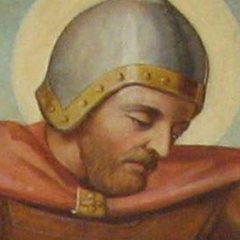 Martin of ToursThe Oak
Being made bishop of Tours did not change Martin. Sulpicius Severus knew him and wrote that no one ever saw him angry or excited, and that “he was always one and the same.”
Martin still lived like a monk. When the crowds visiting his room beside the church grew too much for him, he built a monastery two miles outside the city, a spot so hidden that he lived there like a hermit.
Sulpicius Severus, Life of St Martin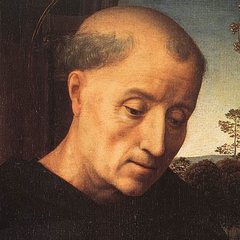 Benedict of NursiaThe Oak
Not even a raider could hurry Benedict of Nursia from his reading. A Goth named Galla tortured a farmer until the farmer, to stop the pain, claimed that he had left everything he owned with Benedict.
Galla tied the farmer's arms and marched him to Benedict's monastery. Benedict was reading at the gate, and when he looked up at the farmer's arms, the cords dropped away. Galla fell trembling at his feet, but Benedict “rose not up from his reading.”
Gregory the Great, Dialogues, book 2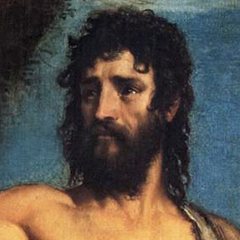 John the BaptistThe Oak
John the Baptist lived in the wilderness until the day he began to preach, and crowds went out there to see him. Jesus asked them whether they had gone out to see “a reed swaying in the wind,” and told them John was no such reed but “more than a prophet.”
Luke 1:80; Matthew 11:7-9sources
Her life
- Luke 10, Berean Standard Bible
- John 11, Berean Standard Bible
- John 12, Berean Standard Bible
- Mark 14 and Matthew 26, Berean Standard Bible
- Luke 7 and Luke 8, Berean Standard Bible
The early Church on her
- Augustine, Sermons 53 and 54 on the New Testament. Tr. R. G. MacMullen, 1888.
- Augustine, Harmony of the Gospels, book 2, chapter 79. Tr. S. D. F. Salmond, 1888.
- John Chrysostom, Homily 80 on Matthew. Tr. George Prevost, rev. M. B. Riddle, in the Nicene and Post-Nicene Fathers, 1888.
- Ephrem the Syrian, Homily on Our Lord. Tr. A. Edward Johnston, 1898.
- Gregory the Great, Homily 33 on the Gospels, in Latin, Migne, Patrologia Latina vol. 76 (1878).
- Gregory the Great, letter to Theoctista. Tr. James Barmby, 1895.
- Egeria, Pilgrimage. Tr. M. L. McClure and C. L. Feltoe, 1919.
- Sulpicius Severus, Dialogues, book 2. Tr. Alexander Roberts, 1894.
- Sulpicius Severus, Life of St Martin. Tr. Alexander Roberts, 1894.
- Gregory the Great, Dialogues, book 2. Tr. P. W., 1608, ed. Edmund G. Gardner, 1911.
Later works and reference
- Jacobus de Voragine, Golden Legend, lives of Mary Magdalene and Martha. Tr. William Caxton, ed. F. S. Ellis, 1900.
- Pliny the Elder, Natural History, book 12, chapter 26. Tr. John Bostock and H. T. Riley, 1855.
- Catholic Encyclopedia, "St. Mary Magdalen" (1910)
- Catholic Encyclopedia, "St. Lazarus of Bethany" (1910)
- Catholic Encyclopedia, "Bethany" (1907)
- Lesser Feasts and Fasts 2022, the Episcopal Church
Calendars
- Righteous Martha and Mary, the sisters of Lazarus, Orthodox Church in America (4 June)
- Sunday of the Holy Myrrhbearing Women, Orthodox Church in America
- Translation of the relics of Lazarus, Orthodox Church in America (17 October)
- Decree on Saints Martha, Mary and Lazarus, Congregation for Divine Worship, 26 January 2021
- Calendarium Romanum (1969), on 22 and 29 July
- Liturgical calendar 2026, United States Conference of Catholic Bishops
- The Calendar, Church of England
- Commemorations, Lutheran Church, Missouri Synod
- The Church Year, Evangelical Lutheran Church in America
Pictures
- Alessandro Allori, Christ in the House of Martha and Mary, 1605. Kunsthistorisches Museum, Vienna. Public domain.
- Henry Scheffer, Jesus with Martha and Mary, 1841. Musée de la Vie romantique, Paris. Public domain.